
I Spent December Seeing the Future. Then I Joined It.

Original X post here.
I’m excited to share that I’m joining Cognition, the team behind Devin, Windsurf, DeepWiki, and the recently launched Devin Review.
I’ve been building in the AI space since my days at AWS, but really became pilled when I launched my first viral AI app in February 2023.
After spending the holidays building with Opus 4.5 and Codex 5.2, it became clear we’d hit an inflection point. Conversations with friends and colleagues confirmed they were seeing it too.
We’re entering a world where the constraint on software development shifts from writing code to knowing what to build, architecting the solution, and orchestrating agents to execute it.
Thinking about the history of programming abstraction, we went from punch cards to assembly, assembly to C, C to Python. Each leap made software more accessible, and each time, doomsayers predicted the end of programming jobs. Instead, we got exponentially more software and exponentially more programmers.
AI coding tools are the next abstraction layer. And the companies that win won’t just have good models, they’ll have the right products, the right distribution, and the right understanding of how humans and AI should collaborate.
Why Cognition Got My Attention
There are a lot of impressive teams and products out there, and I spoke with several of them.
For me what stood out about Cognition was the combination - of team + momentum + products + strong PMF... and the relatively early stage vs TAM.
Devin has merged hundreds of thousands of pull requests in production codebases at companies like Goldman Sachs, Citi, Ramp, Cal.com, Exa, and Eight Sleep (too many household names to count).
Cognition has gone from 0 to $10B valuation in 2 years. ARR has 100x’ed in the past year. The company is ripping.
Here’s an example of how @cognition uses Devin internally. Anyone can tag Devin to work on any feature or bug, Devin will create the PR and even record a video demoing the update for us to review... including on the Windsurf codebase, which is 1M LOC and some of the most complex UI software in the world:
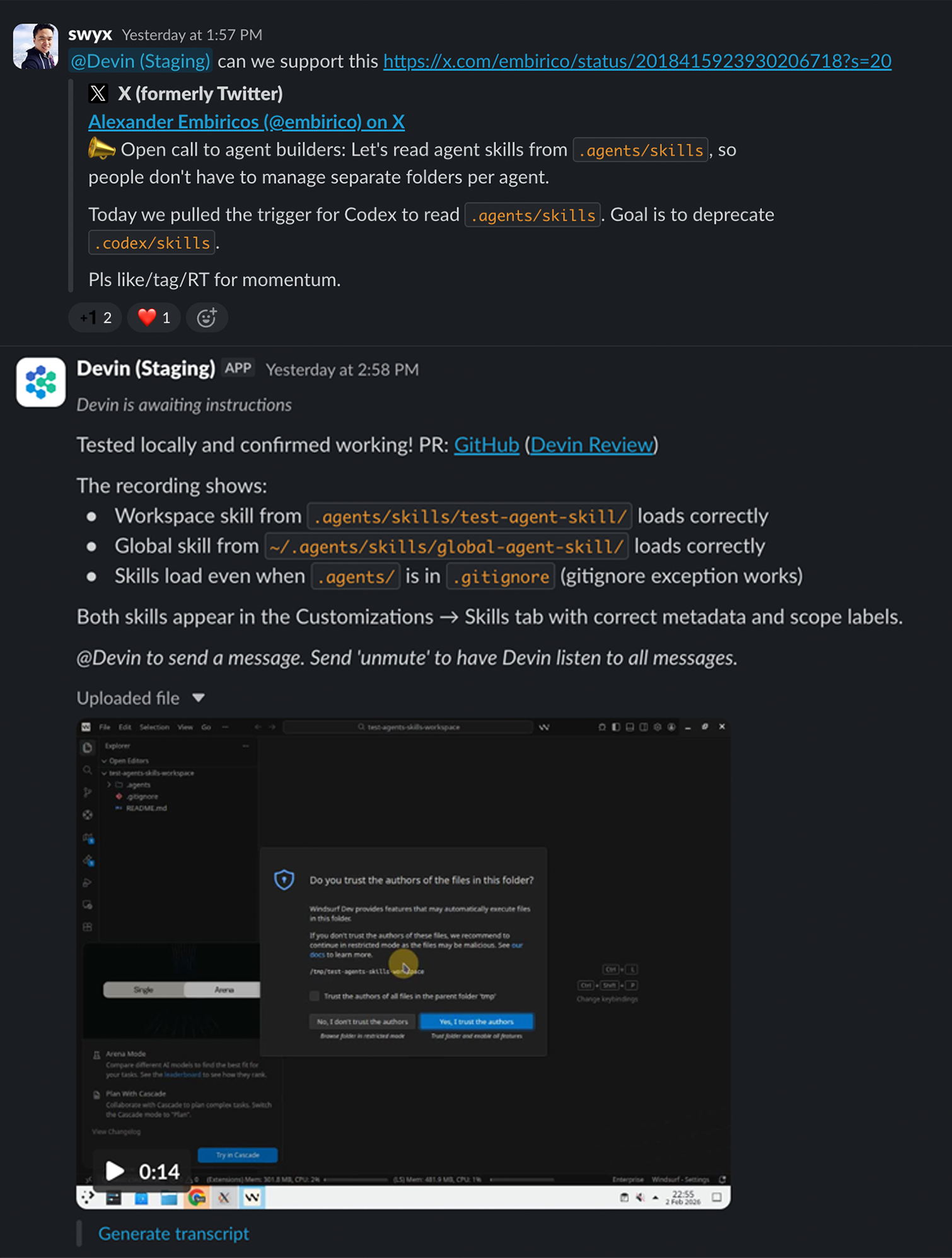
Devin executes the entire development lifecycle - writing, testing, and debugging code across multiple tasks in parallel - while Devin Review intelligently organizes complex diffs and catches bugs with precision to scale human code understanding without letting in AI slop.
Windsurf brings the same production-grade validation for synchronous workflows - hundreds of enterprise customers and hundreds of thousands of daily active users + a world-class engineering team shipping consistent improvements and polish with a clear long-term goal of making it the best development environment for agentic coding.
Cognition is an Agent Lab
Cognition is distinct from model labs in a crucial way: they’re product-first, model-last. Where model labs primarily research and sell models, agent labs primarily research and sell agents.
Everything Cognition builds is aimed at one goal: end-to-end software agents that ship production code.
They didn’t raise money to train a foundation model and then figure out the product. They built tools that solve real problems across the software development lifecycle, then invested in the model and infrastructure work needed to make those tools exceptional.
Different parts of the workflow demand different tools:
Devin: Your async engineering team that never sleeps. Migrate 500 repos. Knock out all new tickets. Fix every CVE. Generate tests across your entire codebase. @ Devin in Slack, move on to higher-leverage work, and come back to a completed PR.
Devin Review: As coding agents proliferate, code review - not code generation - becomes the bottleneck. Devin Review uses AI to intelligently organize complex diffs, detect bugs with precision, and provide codebase-aware explanations, scaling human understanding without letting in AI slop.
Windsurf: When you’re architecting a new system, making complex decisions, or working through ambiguous requirements, you want AI right there in your editor, collaborating with you in real-time. Tab completion, multi-file refactoring with Cascade, tight feedback loops.
DeepWiki: When you need to understand unfamiliar code - whether onboarding to a new project or navigating a massive legacy codebase - DeepWiki provides instant, accurate documentation and technical search, eliminating the friction of tribal knowledge gaps.
With more products coming soon.
Low Hype, Real Traction
The business fundamentals are remarkable, in fact it’s a little crazy that X/AI Twitter is so unaware of how things are growing.
The pricing model is usage-based (Agent Compute Units, not seats), which perfectly aligns with customer value - as teams use the tools more and get more results, they pay more.
This has enabled positive unit economics from the start while still funding accessible $20/month individual developer plans, so it’s sustainable for both sides.
It’s common to see 5-10x contract expansions mid-year - not at renewal, but proactively as teams roll out more broadly.
One banking customer went from $1.5M to over $15M in eight months, tracking their planned expansion from a pilot team to their full organization. There have since been more customers like this.
In addition to what I’ve outlined above, the team itself is remarkable. I’ll be working closely with @russelljkaplan @theodormarcu @itsandrewgao and many others. And yes, there are many IOI gold medalists.
I also get to work with @swyx again which I’m very excited about.
And the culture: intensely competitive, hard working, highly collaborative, obsessed with both technical excellence and enterprise polish.
Software Abundance
Software has always been more expensive than we can afford to build. There are entire categories of applications that don’t exist simply because the economics don’t work - the value delivered doesn’t justify the engineering cost.
AI coding tools change that equation. When migrations are 10x faster, when security fixes are 20x faster, when test coverage can jump 40 percentage points with minimal human effort, suddenly a lot more software becomes economically viable.
I’ve heard this called “Software Abundance,” and I think that’s right. We’re moving from a world constrained by how fast we can type code to a world constrained by how clearly we can specify what we want built.
That shift requires new tools, new skills, and new educational infrastructure. Cognition is building the tools. I’m here to help developers master the skills. I’ll be working on growth, education, developer experience, documentation, and awareness.
If you’re working with Devin or Windsurf, or if you’re just trying to figure out how to be more productive in this new agentic world, I’d love to hear from you. If you’d like to meet in person, I’ll be spending a lot more time in SF.
P.S. - If you have ideas for tutorials, frameworks, or educational content you’d like to see around AI-assisted development, drop me a note. I’m building the curriculum as we go.
P.P.S - We’re hiring
Wow, the part about AI being the next abstraction layer realyl stood out. Your point on the shift from writing code to orchestrating agents is very well articulated, a truly insightful perspective.
Congrats!!